
Doing the work, not seeing progress
You are studying consistently, but your practice results, recall, or confidence are not changing much.
Common exam preparation problem
You are putting in the hours, but your recall, marks, confidence, or exam performance are not shifting.
This is often not an effort problem. It is usually a sign that effort is not converting into retrieval, feedback, mistake repair, or exam-ready performance.
This page helps you identify where your study system may be leaking effort and what to change so preparation becomes more useful.
Orientation
You are not avoiding study. You are not leaving everything to the last minute. You may be doing questions, reading explanations, reviewing notes, attending teaching, or building study plans.
But the result is not shifting enough. The same mistakes keep appearing. The same topics feel familiar but not retrievable. The same pressure shows up in mocks, timed practice, vivas, written answers, or OSCE stations.
The harder you work, the more confusing it becomes when progress is not obvious.
Does this sound familiar?
This is often a preparation-system problem rather than a motivation problem.
You are studying consistently, but your practice results, recall, or confidence are not changing much.
You recognise the errors afterwards, but they keep reappearing in questions, mocks, vivas, or timed practice.
The material makes sense when you read notes or explanations, but it is harder to retrieve or apply under exam conditions.
You are unsure whether the problem is knowledge, technique, timing, pressure, study structure, or mistake review.
Diagnosis
High-stakes medical exams require more than time spent with material. They require retrieval, application, timing, reasoning, communication, mistake review, and performance under exam conditions.
If your study system does not train those skills directly, it is possible to work very hard while still not becoming more exam-ready.
Reading, highlighting, summarising, or watching content can feel productive, but may not test whether you can retrieve and use the information when needed.
Doing more questions is not enough if your review process does not show what the mistake means and what should change next.
If the current method is not producing improvement, repeating it with more intensity may not solve the problem.
Some candidates know content during study but have not trained timing, structure, verbal explanation, written output, or pressure conditions.
Effort conversion map
Study hours only become useful when they pass through the parts of a study system that produce exam-ready performance.
Time, effort, intention, discipline.
Can you produce it without looking?
Do you know what the error means?
Does the mistake change next practice?
Can you do it under exam conditions?
More hours only help if they pass through retrieval, feedback, repair, and exam-condition rehearsal.
Diagnostic map
Use this quick diagnostic map to identify where your study system may be losing impact.
Likely leak: weak retrieval practice. Better next move: test recall before rereading.
Likely leak: weak feedback loop. Better next move: review why errors happened and what should change next.
Likely leak: poor error conversion. Better next move: categorise error types and retest them after a delay.
Likely leak: too little exam-condition rehearsal. Better next move: use smaller timed drills and simulation blocks earlier.
Likely leak: poor prioritisation. Better next move: reduce low-yield resources and protect higher-value practice.
Likely leak: performance-transfer problem. Better next move: practise under mild exam-like conditions and review what changes.
Better next move
When progress has stalled, the next move should change the study system, not just increase the volume.
Better: “Which part of my study system is not changing performance?”
Better: testing recall before rereading.
Better: categorising mistakes and changing next practice.
Better: tracking whether the same error type is reducing.
Better: removing low-yield resources and repeating high-yield practice.
Better: practising smaller exam-condition drills earlier.
System problem
Many doctors are high performers. They are used to working hard, pushing through, and passing exams through discipline.
That history can make this problem confusing. If effort has worked before, it is natural to assume the answer is more effort.
But high-stakes medical exams can expose the limits of older study methods. A method that helped you recognise content may not be enough to retrieve, apply, explain, write, or perform that content under exam conditions.
A study method that helped you recognise content may not be enough if the exam requires you to retrieve, apply, explain, structure, and perform under pressure.
Repair
When effort is not translating into progress, the next step is usually not just more study. The next step is to make study more diagnostic, more active, and more closely connected to the exam task.
Clarify what kind of mistake is happening, not just whether the answer was right or wrong.
Use questions and mocks as feedback systems rather than score checks.
Increase retrieval practice rather than relying mostly on recognition or review.
Build a mistake-review process that changes what you do next.
Practise under conditions that resemble the exam format.
Reduce low-yield resources and focus on fewer higher-yield actions.
Experiment
For one week, do not simply add more hours. Test whether your study system is converting effort into performance.
Choose one weak topic or exam skill.
Test retrieval before reviewing notes.
Do a small timed task or question set.
Categorise mistakes by type.
Repeat the same error type with a new task.
Practise under mild exam conditions.
Check whether the same mistake is reducing.
If nothing changes, the issue may be the design of the practice loop.
1:1 planning
The session is designed to help identify why your current effort may not be translating into improvement, and what to change next.
Look at your study structure, practice methods, mistake review, exam format, timeline, and current pressure points.
The issue may be prioritisation, retrieval, question review, timing, confidence under pressure, or exam-condition rehearsal.
Sometimes the most helpful change is not adding more, but stopping low-yield habits that use time without changing performance.
The aim is to leave with clearer priorities and specific actions for your next stage of preparation.
Scope note
This work does not teach medical content, replace specialty teaching, provide medical advice, or promise exam results.
The focus is on how you prepare, practise, review mistakes, manage pressure, and convert hard work into more reliable exam-ready performance.
Resource note
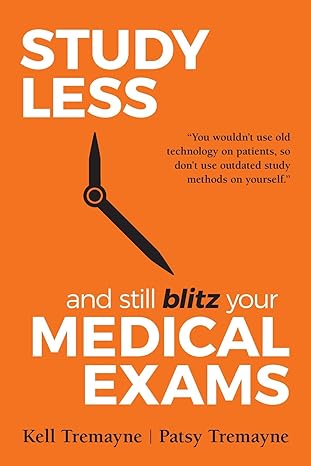
This page draws on practical exam-preparation ideas from Study Less and Still Blitz Your Medical Exams, co-authored by Dr Kell Tremayne and Dr Patsy Tremayne, especially the principle that more study is not always better study. The focus here is how effort becomes exam-ready performance.
FAQ
Hard work may not improve performance if it is not converting into retrieval, feedback, mistake repair, and exam-condition practice. The issue is often the study system, not effort.
Not necessarily. If your current method is not improving performance, more volume may repeat the same pattern. It is usually more useful to identify where effort is leaking.
Look for the bottleneck: weak retrieval, poor mistake review, passive review, poor prioritisation, lack of timed practice, or difficulty performing under exam conditions.
Start with one weak topic or exam skill. Test retrieval, practise under mild exam conditions, categorise mistakes, and check whether the same error type reduces over time.
If your effort is not translating into exam performance, a 1:1 Exam Performance Planning Session can help you identify where preparation is leaking effort and what to change next.


Jul 11, 26 10:42 PM
Jul 11, 26 10:11 PM
Jul 11, 26 09:51 PM