
“I feel like I need to cover everything.”
The problem may be a coverage mindset rather than a readiness plan.
See the coverage trapCommon exam preparation problem
If you cannot cover everything, the next question is not “How do I do more?” It is “What should I do next?”
When everything feels important, urgent, and unfinished, the problem is not always lack of effort. It is often lack of prioritisation.
This page helps you shift from a coverage mindset to a clearer exam-performance plan: what must be done, what should be practised, what needs review, and what can be paused.
Quick diagnosis
Choose the statement that best matches your current problem. Each one points to the kind of repair that is usually more useful than simply adding more material.
The problem may be a coverage mindset rather than a readiness plan.
See the coverage trapThe problem may be weak prioritisation or no clear hierarchy.
Use priority triageThe problem may be load, resource switching, or lack of feedback from practice.
Reduce overloadThe problem may be activity without enough exam-relevant output.
Ask the useful questionUse the dedicated prioritisation guide if you need deeper decision rules.
Go to prioritisation guideThe problem may be unclear priorities, too many resources, or a plan that does not fit real life.
How a session helpsDoes this sound familiar?
The volume of material feels endless, and it is hard to know where to start or what to prioritise.
You may be treating all topics, resources, and tasks as equally urgent, which makes your study plan difficult to sustain.
You start one resource, then switch to another, then feel behind, then try to rebuild the plan again.
Even after studying, there is a constant sense that you have not done enough or have missed something important.
Why overwhelm builds
High-stakes medical exams create a real volume problem. There is a large body of knowledge, multiple possible resources, and often limited time around clinical work and fatigue.
But overwhelm increases when preparation does not distinguish between what is useful, what is urgent, what is high-yield, what needs active practice, and what can be left alone for now.
Covering more material can feel reassuring, but coverage is not the same as readiness. Readiness means being able to retrieve, apply, explain, prioritise, and perform under the conditions the exam actually creates.
Every topic feels equally important, making it hard to decide what to do today.
More resources can fragment attention and make it harder to build a coherent study system.
The plan fails when it does not account for nights, fatigue, recovery, clinical load, and life responsibilities.
Covering material is not the same as producing exam-ready answers, decisions, or performance.
Coverage trap
When the plan is driven mainly by coverage, preparation can become busier without becoming clearer. The result is often more activity, more switching, and less confidence about what is actually improving exam performance.
A coverage mindset can make every task feel urgent and unfinished.
Common trap patterns include resource switching, overloaded plans, low-yield tasks, and weak feedback from practice.
Study feels busy but not necessarily more exam-ready.
Define must-do work.
Use exam-style tasks.
Use errors as feedback.
Stop low-yield work.
Priority triage
If the volume feels overwhelming, sort your study tasks into four categories. The purpose is to make decisions visible rather than letting every task feel equally urgent.
Tasks directly linked to likely exam performance: high-frequency topics, known weak areas, core exam formats, and repeated error patterns.
Useful tasks, but not at the expense of must-do work: secondary resources, extension reading, lower-frequency topics, and extra question sets.
Tasks only if time and capacity allow: polishing notes, extra summaries, additional podcasts or videos, and less relevant deep dives.
Tasks creating activity but not improving readiness enough: switching resources, rewriting notes, passive rereading, and planning instead of practising.
Practical repair
When doctors feel behind, the natural response is often to add more: more resources, more hours, more notes, more question banks, more plans. Sometimes that adds structure. Often it increases overload.
Better study move: reduce active resources and decide which one is primary for content, questions, and feedback.
Better study move: separate must-do topics, exam-like practice, review tasks, and tasks that can be paused.
Better study move: build from your actual roster, fatigue, recovery needs, and realistic study windows.
Better study move: track outputs that matter: questions reviewed, errors repaired, answers produced, and weak areas clarified.
Better study move: use small practice tasks early so feedback can guide priorities.
Better study move: make a good-enough weekly plan with a minimum viable version for difficult weeks.
Better question
When there is too much to cover, the question is not only about getting through the material.
This question can increase coverage pressure and make every task feel equally urgent.
This question shifts preparation toward targeted, exam-relevant work.
Practical reset
If the volume feels overwhelming, use this as a short reset rather than rebuilding the whole plan from scratch.
Choose one primary content resource and one primary question or practice source.
Identify the next three weak areas that matter most for your exam format.
Protect time for retrieval practice, not just reading or note-making.
Review mistakes by type so practice produces feedback.
Decide what to pause this week so higher-value work has space.
Build the week around your actual roster, fatigue, and recovery needs.
Example reset
This is not a complete timetable. It is a simple way to regain direction when the volume feels too large and the plan has become unclear.
Examples: 20 MCQs, one SAQ, one viva answer, or one OSCE station.
Separate knowledge, misreading, reasoning, timing, structure, and pressure errors.
Choose only three areas for the week, based on feedback and exam relevance.
Remove one duplicated resource, passive note task, or excessive planning task.
Reduce load
Candidates with too much to cover often do not only need more discipline. They may need permission to stop low-yield work.
Use different resources only if each has a clear role.
Prioritise retrieval, practice, and feedback over repeated rewriting.
Practice is not only a test of readiness. It is a source of feedback.
Use a restart rule rather than a complete redesign.
Use exam demand, error patterns, and weak areas to decide priority.
Ask whether the task is improving exam performance, not only making you feel briefly reassured.
Exam-format priorities
“Too much to cover” looks different depending on the exam format. Use the format to decide what kind of preparation should move up the priority list.
Move question review, repeated error types, weak concepts, and distractor patterns up the priority list.
MCQ preparationMove answer structure, mark allocation, timed written output, and command words up the priority list.
SAQ preparationMove spoken frameworks, retrieval under pressure, concise answer structure, and recovery after prompts up the priority list.
Viva preparationMove station routines, cue recognition, clinical sequence, and recovery between stations up the priority list.
OSCE preparationPersonalised planning support
If every task feels important, the 1:1 Exam Performance Planning Session can help separate what is essential, what is useful, what can wait, and what is adding unnecessary load.
Look at your exam timeline, available time, current resources, known weaknesses, and practice feedback to identify what deserves attention first.
Identify low-yield habits, duplicated resources, or study tasks that are using time without improving readiness.
Look at what can realistically fit around clinical work, fatigue, recovery, and life responsibilities.
Connect preparation to exam demands: retrieval, reasoning, timing, communication, judgement, and performance under pressure.
Scope note
This work does not teach medical content, replace specialty teaching, provide medical advice, or promise exam results.
The focus is on how you prepare, prioritise, practise, review mistakes, manage pressure, and convert hard work into more reliable exam-ready performance.
Common questions
No. The aim is not equal coverage. The aim is readiness for the highest-value exam demands.
Use exam format, feedback from questions or mocks, repeated errors, and high-risk weak areas.
Yes, if it is duplicating work, creating overload, or not improving exam readiness.
Start with a reset: one practice task, one review task, three priority targets, and one thing to pause.
Resource note
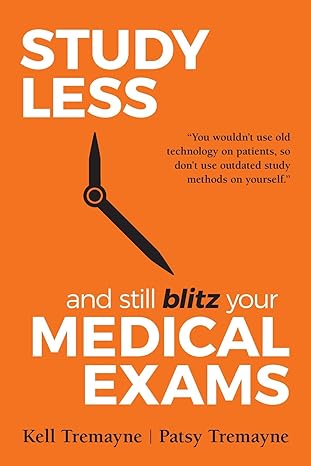
This approach builds on the practical exam preparation principles in Study Less and Still Blitz Your Medical Exams, co-authored by Dr Kell Tremayne and Dr Patsy Tremayne, and adapts them to individual exam performance planning.
If the volume of material feels overwhelming, a 1:1 Exam Performance Planning Session can help you clarify priorities, reduce unnecessary load, and decide what to focus on next.


Jul 11, 26 10:42 PM
Jul 11, 26 10:11 PM
Jul 11, 26 09:51 PM