
Flat scores
You are doing questions, but the score is not shifting. Likely issue: weak feedback loop.
Use the feedback loopCommon exam preparation problem
Practice questions can be useful, but only if they change what you do next. If you are doing questions without improving, the issue may be how the feedback is being used.
More questions do not automatically create better exam performance. The aim is to use each question to identify what to study, practise, review, or stop doing next.
This page helps you turn question practice into a diagnostic feedback system rather than another way to measure confidence.
Quick pattern check
Most candidates do not simply need “more questions”. The more useful first step is to identify what question practice is failing to change.
You are doing questions, but the score is not shifting. Likely issue: weak feedback loop.
Use the feedback loopYou understand the correct logic once you see it. Likely issue: recognition without retrieval or reasoning.
Check mistake typesDifferent questions, but the same underlying error. Likely issue: mistakes are not being classified.
Map mistake to actionEach block feels like a verdict. Likely issue: questions are being used as testing, not feedback.
Use scores as signalsChoose your pathway
You do not need to read this page in order. Start with the pattern that best matches your question-practice problem.
Look at whether questions are producing clear next actions, not just results.
Use the feedback loopThe issue may be producing the reasoning under exam conditions, not recognising it afterwards.
Check mistake typesThe topic may change, but the underlying error pattern may be repeating.
Map mistake to actionMore volume may not help if the review process is not changing behaviour.
See stuck patternsScores matter, but repeated signals are usually more useful than a single result.
Use scores as signalsA 1:1 session can help identify how to make question practice more useful.
How a session helpsDoes this sound familiar?
Doctors often describe this problem in one of these ways. The issue is not always that you are doing too few questions.
You may be completing regular practice, but the results are staying flat or improving only slightly.
The answer makes sense when you review it, but that does not always mean you could produce the reasoning under exam conditions.
The specific topic may change, but the underlying error pattern keeps repeating.
Practice becomes a judgement of whether you are ready, rather than a tool for deciding what to change next.
Core concept
A question can tell you more than whether you were right or wrong.
It can show whether the problem was knowledge, recall, interpretation, timing, prioritisation, reasoning, confidence, fatigue, or performance under pressure.
But the question only becomes useful if that information changes what you study, practise, review, or stop doing next.
Question practice feedback loop
A useful question session does more than produce a score. It helps you identify the type of error, the likely cause, and the next action required before you re-test the pattern.
Complete the question under conditions close enough to reveal how you actually perform.
Look beyond right or wrong and notice the decision, hesitation, misread, or reasoning step.
Decide whether the issue was knowledge, retrieval, interpretation, reasoning, timing, or pressure.
Turn the pattern into a specific study, practice, review, or exam-condition rehearsal action.
Check whether the corrected pattern holds in a similar or more exam-like task.
Questions improve performance when they change the next repetition.
Why questions stall
Practice questions are valuable because they reveal how you retrieve, interpret, reason, prioritise, and decide under exam-like demands.
But they only lead to improvement when the review process identifies the reason for the mistake and turns that reason into a specific next action.
If every incorrect answer is treated as “I need to study that topic again,” important performance patterns can be missed.
Reading the explanation can help, but it may not reveal why you chose the wrong answer or missed the key feature.
Some errors are due to missing knowledge. Others come from misreading, poor prioritisation, rushing, overthinking, or weak exam strategy.
If question review does not change what you study, practise, or rehearse next, the feedback loop is incomplete.
Scores matter, but they do not always show the underlying pattern of errors that needs attention.
Common trap
If the explanation makes sense afterwards, it is easy to think the problem is fixed. But recognising the explanation is not the same as being able to produce the reasoning under exam conditions.
Notice why the wrong answer seemed plausible at the time.
Look for the key word, qualifier, discriminating feature, or task in the stem.
Identify the step between recognising the topic and choosing the answer.
Test whether the answer can be retrieved and explained closed-book.
Choose one behaviour for the next similar question.
If every mistake becomes “revise the topic,” the review process misses retrieval, interpretation, timing, reasoning, and pressure patterns.
Review depth ladder
Question review becomes more useful as it moves from score-checking toward behaviour change and re-testing.
“I got 62%.”
“I need to revise cardiology.”
“This was a reasoning error.”
“I need to compare the top two options before answering.”
“I will do 10 similar questions timed tomorrow.”
Better review does not just explain the past mistake. It changes the next repetition.
Mistake diagnosis
A wrong answer is not always a simple knowledge gap. The same score can come from very different problems, and each problem needs a different next action.
You did not know the relevant information, framework, clinical distinction, or concept.
You had studied the material, but could not access it quickly or clearly during the question.
You missed a key word, misread the stem, or did not identify what the question was asking.
You had some of the knowledge, but did not choose the best next step or most appropriate answer.
You moved too quickly, skipped a step, missed a cue, or made an avoidable error under time pressure.
You changed a reasonable answer, over-checked, or lost confidence when certainty was incomplete.
Mistake type to next action
A wrong answer becomes useful when it helps you choose the right repair. A knowledge gap, retrieval problem, misread stem, rushing error, and second-guessing pattern should not all lead to the same kind of review.
Meaning: missing concept, fact, framework, or clinical distinction. Next action: targeted content repair, then closed-book recall and similar exam-style questions.
Meaning: studied material was not accessible quickly. Next action: timed recall, short closed-book explanations, and repeated retrieval before returning to notes.
Meaning: missed key word, cue, qualifier, or task. Next action: practise stem-reading, cue identification, and naming the task before answering.
Meaning: knowledge was present but the best option was not selected. Next action: compare top options, explain why one is better, and use decision rules.
Meaning: pace disrupted accuracy. Next action: slow-to-fast timed practice, checking routines, and pacing without losing accuracy.
Meaning: uncertainty drove answer changes or hesitation. Next action: change answers only for a specific misread, missed cue, or reasoning correction.
Try this after your next block
Use this after a short question block, mock set, or group of difficult questions. The goal is to turn the result into a concrete next action.
Correct, incorrect, guessed, changed answer, rushed, or ran out of time.
Knowledge, retrieval, interpretation, reasoning, timing, or second-guessing.
Why did the wrong answer seem plausible at the time?
Content repair, closed-book recall, stem-reading, timing drill, or decision rule.
Similar question, timed mini-block, oral explanation, or written summary.
A useful review ends with a behaviour you can repeat, not just a topic you need to “look over again”.
Stuck practice patterns
When question practice is not improving performance, the natural response is often to do more questions. More practice may help if the feedback loop is working. But if review is weak, more questions may simply repeat the same error patterns.
Moving rapidly through questions can create activity without enough learning from the mistakes.
Understanding the explanation afterwards is not the same as being able to produce the reasoning during the exam.
More questions may not help if the same error patterns keep repeating.
If every score becomes a confidence check, questions can increase stress rather than improve preparation.
Review system
When practice questions are not improving performance, the goal is to make review more diagnostic. The review process should help you decide what to study, what to practise, what to stop doing, and what pattern to watch for next.
Sort mistakes by type, not just topic.
Separate knowledge gaps from retrieval, interpretation, timing, and reasoning problems.
Identify why the wrong answer felt plausible at the time.
Identify repeated patterns across questions, mocks, or cases.
Turn each repeated error pattern into a specific next action.
Use questions to guide priorities, then re-test the corrected pattern under exam-like conditions.
Better question
When practice questions are not improving performance, the question is not only about volume.
Question volume matters, but it can become a misleading measure if the review process is not changing what happens next.
This shifts practice from score-checking toward feedback, diagnosis, and targeted repair.
Scores and signals
Scores can be useful, but they can also become distracting if every result is treated as a verdict on readiness. A single score may fluctuate for many reasons. Repeated patterns across questions are often more useful.
Ask what the score and the mistakes are suggesting about preparation, rather than treating every result as a simple pass/fail judgement.
A knowledge gap needs a different response from a rushing error, a misread stem, weak reasoning, poor retrieval, or a second-guessing pattern.
Worked examples
These examples show how the same question result can lead to very different next actions depending on the mistake type.
Situation: you read the explanation and think, “Of course, I knew that.” Less useful: treat it as careless and move on. Better: practise closed-book recall before reading the explanation.
Situation: you miss “most likely,” “except,” or the key discriminating feature. Less useful: reread the whole topic again. Better: practise stem cue identification before answering.
Situation: your first answer was correct, but you changed it. Less useful: promise yourself not to overthink. Better: create answer-change rules based on specific cues.
Personalised planning support
The 1:1 Exam Performance Planning Session is designed to help you step back from question volume and examine whether your practice is actually changing performance.
The aim is not simply to do more questions. It is to understand what your question practice is revealing, what repeated mistakes are signalling, and what should change next.
Look at how you are using questions, mocks, cases, or past papers and whether your review process is changing what you do next.
The issue may relate to content, recall, reasoning, timing, question interpretation, confidence, or pressure.
Make review more useful and targeted, not simply more detailed or time-consuming.
Leave with clearer priorities for how to use questions more effectively in the next stage of preparation.
Scope
This work does not teach medical content, replace specialty teaching, provide therapy, or promise exam results.
Using questions as feedback, classifying mistake types, turning errors into next actions, and improving review and re-testing systems.
Replacing medical content teaching, doing as many questions as possible, using scores as a verdict on readiness, or promising exam results.
The focus is on how you use questions, review mistakes, practise under exam conditions, and convert hard work into more reliable exam-ready performance.
Common questions
More questions can help if the feedback loop is working. If mistakes are not being classified and repaired, more volume may simply repeat the same patterns.
Explanations can feel obvious once you see them. The important question is whether you could retrieve, interpret, and reason through the answer under exam conditions.
Not necessarily. The goal is not to make review endless. The goal is to identify repeated patterns and turn them into specific next actions.
A single score can fluctuate for many reasons. Repeated error patterns are usually more useful than one isolated result.
Resource note
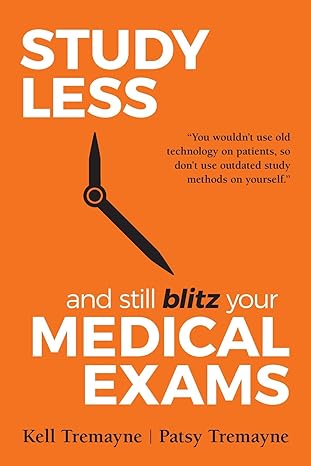
This approach builds on the practical exam preparation principles in Study Less and Still Blitz Your Medical Exams, co-authored by Dr Kell Tremayne and Dr Patsy Tremayne, and adapts them to individual exam performance planning.
A 1:1 Exam Performance Planning Session can help identify whether your question practice is revealing knowledge gaps, retrieval problems, reasoning errors, timing issues, or pressure patterns — and turn those into clearer next actions.


Jul 11, 26 10:42 PM
Jul 11, 26 10:11 PM
Jul 11, 26 09:51 PM