
Freeze
You pause, go blank, lose your opening structure, or cannot access what you know.
Useful repair: Retrieval starts, restart phrases, and simple structures.
Review repair optionsCommon exam preparation problem
Some doctors know the material in study but struggle to access, organise, decide, or communicate when the exam becomes timed, pressured, unfamiliar, or high stakes.
This is often not simply a confidence problem. It is usually a performance-translation problem: preparation needs to include retrieval, structure, decision-making, timing, and recovery under exam-like conditions.
This page helps you identify whether the main pressure pattern is freezing, rushing, second-guessing, weak structure, or practice that does not resemble the real exam.
Quick pattern check
Most candidates do not have one single problem. But one pattern usually explains what breaks first when the exam becomes pressured.
You pause, go blank, lose your opening structure, or cannot access what you know.
Useful repair: Retrieval starts, restart phrases, and simple structures.
Review repair optionsYou read too quickly, miss cues, jump to conclusions, or lose accuracy.
Useful repair: Timed reading, cue checks, and stop-points.
Review repair optionsYou change answers, over-check, hesitate, or struggle to commit.
Useful repair: Answer-change rules and uncertainty practice.
Review repair optionsOne bad question, station, or prompt affects the next part of the exam.
Useful repair: Recovery and reset routines.
Review recovery practiceQuick diagnosis
Choose the statement that best matches your exam-pressure pattern. Each one points to a different kind of practice repair.
The issue may be a performance translation gap.
Likely problem: Knowledge is not transferring into exam-condition performance.
Better next action: Practise retrieval, timing, structure and recovery.
Start hereThe pressure pattern may be disrupting execution before knowledge.
Likely problem: A pressure-specific performance pattern is interfering with retrieval, timing or decision-making.
Better next action: Identify the pattern and practise the repair.
Identify the patternPractice may be too comfortable, slow, private, or untimed.
Likely problem: Practice is not representative enough of the real exam.
Better next action: Build pressure gradually.
Build pressure graduallyThe repair may need more than content review.
Likely problem: The practice target is unclear.
Better next action: Practise specific exam-condition behaviours.
Choose practice targetsMCQ, SAQ, viva and OSCE pressure patterns often look different.
Likely problem: The pressure pattern is format-specific.
Better next action: Choose the repair by exam format.
Choose by formatThe pressure point may be difficult to identify alone.
Likely problem: The performance bottleneck is unclear.
Better next action: Use a session to diagnose the pressure pattern.
How a session helpsDoctors often describe this problem in one of these ways. The pattern may only appear when the exam becomes timed, public, uncertain, or high stakes.
The knowledge may be there, but it becomes harder to access when time pressure, uncertainty, or the examiner’s presence changes the conditions.
You may read too quickly, miss key details, jump to conclusions, or lose your usual checking process under time pressure.
You may change answers, over-check, hesitate, or struggle to commit when certainty is incomplete.
You may be studying content, but not rehearsing the pace, structure, uncertainty, and pressure of the exam itself.
Knowing something in study is not always the same as being able to produce it under exam conditions.
Medical exams often require candidates to retrieve information quickly, select what matters, organise a response, communicate clearly, manage time, and continue despite uncertainty.
If your preparation mostly trains content familiarity, but the exam requires timed performance, then the missing part may be the translation layer between knowledge and output.
Performance translation gap
If preparation mostly trains knowledge familiarity, there can be a gap between what you know during study and what you can produce when the exam adds time pressure, uncertainty, structure, communication, and performance demands.
Study setting
You may understand the content when reviewing notes, reading explanations, or discussing cases calmly.
Exam demands
The exam adds demands that are not always trained by content review alone.
Exam setting
The task is to retrieve, organise, decide, communicate, and recover while the exam conditions are present.
High-stakes medical exams do not only test what you know. They also test whether you can retrieve, organise, apply, communicate, and decide under pressure.
If most practice happens slowly, privately, or with unlimited time, a candidate may become familiar with content without becoming practised at producing it under exam-like demands.
You may understand the material during revision, but have difficulty retrieving or applying it quickly when the exam setting changes the demands.
Preparation may involve reading, reviewing, or untimed questions, but not enough rehearsal under the actual conditions of the exam.
In oral, viva, OSCE, clinical, or written exams, pressure can make it harder to organise an answer clearly.
When a question feels ambiguous, candidates may slow down, over-check, change answers, or lose confidence in otherwise reasonable decisions.
Pressure pattern diagnosis
These patterns can feel similar because they all happen under pressure. But they usually need different practice repairs.
| Pressure pattern | More useful practice repair |
|---|---|
| Freezing or going blank | Practise short retrieval starts, simple answer structures, restart phrases, and recovery after a pause or blank. |
| Rushing and missing details | Practise timed reading, deliberate first-pass decisions, checking cues, and small stop-points before committing to an answer. |
| Second-guessing reasonable answers | Practise decision rules, uncertainty tolerance, answer commitment, and review of when answer changes help or harm. |
| Losing structure under pressure | Practise compact frameworks for answers, cases, clinical sequences, or stations until the structure becomes easier to access. |
| One bad moment affecting the rest | Practise recovery between questions, prompts, or stations so one difficult moment does not control the next part of the exam. |
Pressure response chain
The goal is not to remove every sign of pressure. The goal is to recognise the chain earlier and practise a repair before one moment affects the rest of the performance.
Uncertainty or pressure appears: a difficult question, examiner prompt, time cue, unfamiliar station or perceived mistake.
Freeze, rush or second-guess: the response changes retrieval, accuracy, structure, timing or decision-making.
Recover and continue: use a restart phrase, cue check, decision rule, or reset routine.
When doctors freeze, rush, or second-guess, the natural response is often to assume the solution is more content, more confidence, or more reassurance.
Sometimes knowledge gaps are part of the problem. But if the difficulty appears mainly under pressure, then content review alone may not train the performance required.
Reading can increase familiarity, but it may not train rapid retrieval, structure, timing, or decision-making.
Confidence often follows repeated, well-designed practice. It does not always arrive before the work begins.
Avoiding uncomfortable practice can make the real exam feel even more unfamiliar.
Review matters, but candidates also need to practise how to think and respond during the task itself.
Better practice target
When the problem appears under exam conditions, preparation needs to include those conditions more deliberately. The aim is to practise the performance you need to produce, not just the content you need to know.
| Practice target | What it trains |
|---|---|
| Timed retrieval | Practise retrieval under time limits rather than only reviewing content. |
| Exam-format prompts | Use prompts, cases, stems, stations, or questions that resemble the exam format. |
| Simple answer structures | Build simple answer structures that hold when pressure increases. |
| Decision and move-on practice | Practise deciding and moving on when certainty is incomplete. |
| Mistake-process review | Review not only what was wrong, but how the mistake happened. |
| Recovery practice | Practise recovery after an error, pause, blank, or difficult question. |
Pressure practice ladder
Exam-condition performance does not need to be trained all at once. A useful approach is to build pressure gradually, so you practise retrieval, structure, timing, uncertainty, and recovery in manageable steps.
| Step | Practice level | What to practise |
|---|---|---|
| 1 | Low-pressure retrieval | Recall key information without notes before checking resources. |
| 2 | Timed retrieval | Practise producing answers within realistic time limits. |
| 3 | Structured responses | Use simple answer structures that hold when pressure increases. |
| 4 | Exam-like rehearsal | Practise with cases, prompts, stations, questions, or mock conditions. |
| 5 | Recovery practice | Practise continuing after an error, blank, hesitation, or difficult question. |
Try this this week
Use this after one question, prompt, station, or answer attempt where pressure changed your performance.
Did you freeze, rush, second-guess, lose structure, or carry the mistake forward?
What did it affect: reading, recall, reasoning, timing, structure, communication, or recovery?
Pick one behaviour to practise next time: slow first pass, answer opener, reset phrase, or decision rule.
When you freeze, rush, or second-guess, the question is not only about whether you know enough.
“Do I know enough?” This may be relevant, but it can keep preparation focused only on content familiarity.
“Have I practised producing the required performance under the conditions the exam creates?” This shifts preparation toward retrieval, timing, structure, uncertainty, communication, and recovery.
Pressure and recovery
Pressure is part of high-stakes medical exams. The aim is not to eliminate all nerves or wait until you feel completely calm. The aim is to prepare so you can function effectively even when the exam feels pressured, uncertain, or imperfect.
Preparation should include the behaviours you need under pressure: reading carefully, structuring responses, making decisions, managing time, and continuing after uncertainty.
Preparation should include recovery practice: how to pause, regain structure, move on, and continue performing after a difficult question, blank, prompt, or imperfect response.
Worked examples
A pressure pattern becomes easier to repair when it is translated into a small, specific practice task. The aim is not to make practice harder for its own sake, but to make it more like the performance you need to produce.
Situation: you read too fast, miss words such as “except” or “most likely”, and later realise the mistake was avoidable. Less useful: do more questions at the same speed and hope accuracy improves. Better: practise timed blocks with a deliberate first-pass cue check before selecting an answer.
Situation: you know the topic, but struggle to start the answer when the examiner asks the question. Less useful: reread notes and hope confidence returns before practising aloud. Better: practise 20-second answer openers, simple frameworks, and restart phrases.
Situation: one difficult station keeps replaying in your head and affects the next station. Less useful: review the clinical content only after the mock. Better: practise a between-station reset routine: release, refocus, and restart.
Exam-format guidance
Freezing, rushing, and second-guessing can look different depending on the exam format. Use the format to choose the practice repair.
Personalised planning support
The 1:1 Exam Performance Planning Session is designed to help you identify where performance breaks down under pressure and what kind of practice is most likely to help.
The aim is not simply to tell you to be calmer or more confident. The aim is to identify the pressure pattern and build a practice system that better matches the exam demands.
We look at whether the main issue appears to be freezing, rushing, second-guessing, timing, structure, recall, uncertainty, or exam-condition rehearsal.
We examine whether your preparation is close enough to the format, pace, uncertainty, and pressure of the exam you are facing.
The aim is to make practice more representative and useful, not simply more intense or more stressful.
You leave with clearer actions for how to study, practise, review mistakes, and prepare for performance under pressure.
Scope
This work does not teach medical content, replace specialty teaching, provide therapy, or promise exam results.
The work is performance-focused: identifying what happens under exam conditions, designing better practice, and building routines for retrieval, structure, timing, decision-making and recovery.
Common questions
Not always. Sometimes there is a knowledge gap, but freezing can also reflect difficulty retrieving, structuring, or starting an answer under pressure.
Rushing usually needs practice with timed reading, deliberate first-pass decisions, checking cues, and small stop-points before committing to an answer.
No. Changing an answer can be useful if you identify a specific misread or reasoning correction. It becomes a problem when uncertainty alone drives repeated changes.
Practice exams can help, but only if they are reviewed well. The useful question is what the practice reveals about timing, structure, decision-making, retrieval, or recovery.
Yes. You can build from low-pressure retrieval to timed retrieval, structured responses, exam-like rehearsal, and recovery practice.
No. This page is focused on exam preparation and performance practice. It does not provide therapy or mental health treatment.
Resource note
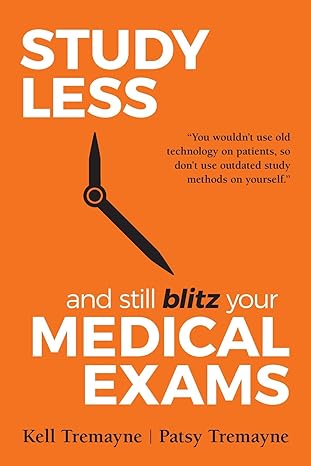
This approach builds on the practical exam preparation principles in Study Less and Still Blitz Your Medical Exams, co-authored by Dr Kell Tremayne and Dr Patsy Tremayne, and adapts them to individual exam performance planning.
A 1:1 Exam Performance Planning Session can help identify whether the main issue is freezing, rushing, second-guessing, structure, timing, or recovery — and build a more targeted practice plan.


Jul 11, 26 10:42 PM
Jul 11, 26 10:11 PM
Jul 11, 26 09:51 PM