
I cannot retrieve it quickly enough
You know the content when reviewing, but it is harder to access under time pressure.
Likely problem: retrieval under exam conditions. Useful repair: timed recall and exam-format prompts.
Review the breakdown mapCommon exam preparation problem
Some candidates know the material during study but cannot reliably turn that knowledge into clear, structured, mark-scoring performance under exam conditions.
This can be frustrating because the problem does not always feel like a simple knowledge gap. You may recognise the topic, understand the explanation, or know the diagnosis, but still fail to show that knowledge clearly in the exam.
This page helps you identify whether the issue is retrieval, structure, answer selection, reasoning, timing, communication, or exam-format practice.
Quick diagnosis
If you know the content but cannot show it in the exam, the problem may occur at different points between study knowledge and exam output.
You know the content when reviewing, but it is harder to access under time pressure.
Likely problem: retrieval under exam conditions. Useful repair: timed recall and exam-format prompts.
Review the breakdown mapYou understand the topic, but your answers become too broad, unfocused, or overloaded.
Likely problem: selection and prioritisation. Useful repair: practise answering the question asked.
Review the breakdown mapThe knowledge is there, but the answer becomes scattered, incomplete, or hard to follow.
Likely problem: weak output structure. Useful repair: use simple answer frameworks.
Review the breakdown mapYou arrive at an answer but do not make the reasoning visible enough for marks.
Likely problem: hidden reasoning. Useful repair: explain the pathway, not just the answer.
Review the breakdown mapYou know what to say but cannot produce it efficiently within the time available.
Likely problem: timing and answer economy. Useful repair: timed output practice.
Review the breakdown mapYour performance changes when the task becomes timed, marked, public, or high stakes.
Likely problem: exam-condition translation. Useful repair: staged exam-like rehearsal.
Review the breakdown mapStart here
Choose the statement that best matches what happens when you try to turn knowledge into exam performance.
The opening step may not be practised enough.
Likely problem: weak retrieval start. Better next action: practise short answer openers.
Use the practice ladderThe concept may be understood, but the exam output may not show enough specificity.
Likely problem: insufficient mark-visible detail. Better next action: practise making reasoning explicit.
See examplesThe answer may not be targeted to the question or marking frame.
Likely problem: poor selection. Better next action: practise command words, mark allocation, and answer scope.
Review the breakdown mapThe problem may be retrieval under pressure rather than knowledge storage.
Likely problem: low exam-condition retrieval. Better next action: practise timed recall before reviewing notes.
Choose practice targetsThe content may need a more reliable structure.
Likely problem: weak answer framework. Better next action: practise repeatable structures for common question types.
Choose practice targetsThe output problem may be hard to diagnose alone.
Likely problem: unclear bottleneck. Better next action: use a session to identify where knowledge is being lost.
How a session helpsCandidates often describe this problem as knowing the material in one setting but not being able to show it clearly when the exam requires output.
You can follow the reasoning when reading or discussing, but your own answer does not reproduce that reasoning clearly.
You may reach the right answer but fail to show the steps, justification, or clinical reasoning expected by the examiner.
You include content you know, but not necessarily the content that answers the question or earns marks.
Once pressure is gone, the answer becomes clearer, which suggests an output or performance issue rather than only a content issue.
Medical exams do not usually reward private understanding alone. They reward what the candidate can produce in response to the question, station, prompt, or case.
A candidate may understand the topic but still lose marks if the answer does not select the right information, show the reasoning, use the required structure, or fit the time available.
That means preparation needs to train more than content familiarity. It also needs to train the conversion of knowledge into exam-format output.
Knowledge-to-output gap
If revision mostly trains recognition and familiarity, there can be a gap between what you know and what you can produce in a marked exam response.
You may understand the content when reading, reviewing notes, watching explanations, or discussing cases calmly.
The exam requires selection, structure, reasoning, wording, timing, and communication.
The examiner can only mark what is shown clearly in the response, not what was understood privately.
Knowing content and showing content are related, but they are not identical skills.
You may recognise the answer when reading but struggle to produce it without cues, notes, or unlimited time.
You may include true information, but not the information that answers the specific question.
You may think through the answer internally but not show enough reasoning for the examiner to award marks.
Answers can become scattered when the exam requires fast organisation under pressure.
You may know what to say but not produce it quickly or efficiently enough.
Reading and reviewing can build familiarity without training exam-format output.
Output diagnosis
A useful repair depends on where the knowledge is being lost between study and exam output.
You know it afterwards but cannot access it quickly.
Practice repair: Practise timed recall before checking notes.
You write too much or answer around the question.
Practice repair: Practise identifying the exact task, command word, and mark focus.
The answer is correct but disorganised.
Practice repair: Practise repeatable answer frameworks.
The answer names the result but does not show the pathway.
Practice repair: Practise explaining why, not just what.
You cannot finish or show enough detail.
Practice repair: Practise timed output and answer economy.
The answer collapses in mock or exam conditions.
Practice repair: Practise staged exam-like rehearsal and recovery routines.
When candidates cannot show what they know, the natural response is often to do more content review. Sometimes that helps. But if the problem is output, content review alone may not be enough.
This can increase familiarity without improving retrieval or answer production.
This may help understanding, but it does not prove you can produce the answer yourself.
Practice volume helps less if you do not examine how your answer was constructed.
Output skills usually improve through repeated attempts, not by waiting until confidence appears first.
Better practice target
These practice targets train the conversion from private knowledge into visible, mark-relevant exam output.
Retrieving knowledge without prompts.
Turning knowledge into output within exam time.
Answering the task the question is actually asking.
Organising knowledge so the examiner can follow it.
Showing the steps behind the answer.
Reviewing whether the answer showed enough to earn marks.
Practice ladder
Try this this week
Use this after one written answer, oral response, question block, or practice station where the mark did not match what you thought you knew.
Was the problem retrieval, selection, structure, reasoning, timing, or pressure?
What did the answer fail to show clearly enough for the examiner?
Repeat the answer with one improvement: clearer opening, tighter structure, shown reasoning, or better time control.
“Do I know this?” This can keep preparation focused on private understanding rather than exam output.
“Can I show this clearly enough, in the format and time the exam requires?” This shifts preparation toward mark-visible performance.
Worked examples
Situation: you know the disease process but write a general answer that misses key marking points. Less useful: reread the whole topic again. Better: practise writing a targeted answer using the command word and mark allocation.
Situation: you understand the topic but cannot organise a spoken answer when asked directly. Less useful: wait until you feel confident before practising aloud. Better: practise a short opening sentence and a simple three-part answer structure.
Situation: you choose an answer but cannot explain why the distractors were wrong. Less useful: only count the question as right or wrong. Better: review whether you could explain the reasoning pathway and the cue that mattered.
Exam-format guidance
Personalised planning support
The 1:1 Exam Performance Planning Session can help identify where knowledge is being lost between study and exam output.
The aim is not simply to add more content. The aim is to clarify whether the issue is retrieval, selection, structure, reasoning, timing, pressure, or review quality.
We identify where the answer breaks down between knowledge and exam performance.
We examine whether preparation is training recognition, recall, structured output, or exam-condition performance.
We identify whether to focus on retrieval, answer structure, reasoning, timing, or pressure rehearsal.
You leave with a clearer practice plan for turning knowledge into exam-format output.
Scope
The work is performance-focused: identifying why known content is not appearing clearly in exam output, then designing practice that makes knowledge more visible, structured, and mark-relevant.
Common questions
Not always. Sometimes there is a knowledge gap, but often the problem is that knowledge is not being retrieved, structured, or shown clearly under exam conditions.
After the exam, pressure and time demands are reduced. That can make retrieval and organisation easier. This may suggest the need for exam-condition retrieval and output practice.
Practise identifying the command word, mark allocation, key cues, and the specific reasoning the examiner needs to see.
Content review may still matter, but it should be paired with output practice: closed-book recall, timed answers, structured responses, and mark-focused review.
If your answer contains correct ideas but feels scattered, incomplete, or hard to follow, structure may be the bottleneck.
Yes. Candidates can often improve by practising the specific conversion from knowledge into exam-format output.
Resource note
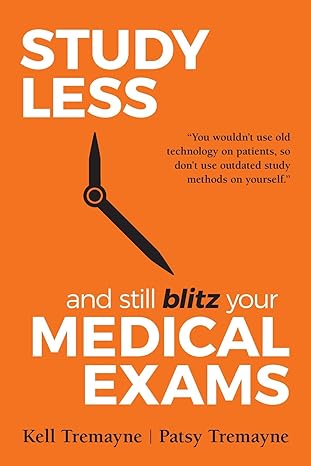
This approach builds on the practical exam preparation principles in Study Less and Still Blitz Your Medical Exams, co-authored by Dr Kell Tremayne and Dr Patsy Tremayne, and adapts them to individual exam performance planning.
A 1:1 Exam Performance Planning Session can help identify where knowledge is being lost between study and exam output, and build a more targeted practice plan.


Jul 11, 26 10:42 PM
Jul 11, 26 10:11 PM
Jul 11, 26 09:51 PM